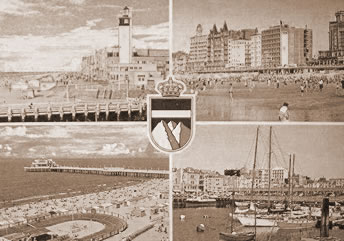
From fishing village to town (1100 to 1800)
For centuries Blankenberge was a small community of fishermen who simply pulled their boats up onto the beach.
- Between two dykes (around 1100): the first settlement lay between the Oostdijk and the Westdijk, today's Hoogstraat and Weststraat.
- Town rights (1270): in 1270 Blankenberge separated from the parish of Uitkerke and received town rights from Countess Margaret of Constantinople.
- A sizeable fleet: in the 13th century the fishing fleet already counted more than 60 boats, and from 1418 the sea was blessed by a priest every year.
- The lighthouse: as early as 1337 a lighthouse stood east of the village; in 1526 a new stone tower followed, modelled on those of Ostend and Nieuwpoort.
- Sint-Antonius Abtkerk (1335 to 1358): after a severe storm in 1334 and 1335 a new church was built, today's Sint-Antonius Abtkerk, which was set on fire by the English in 1405.
- Fishermen on the beach: the fishermen sailed flat-bottomed boats that landed on the beach; a real harbour only came in 1871, with a harbour channel and a wooden jetty.
- Old Town Hall (around 1680): the Oud Stadhuis in Flemish Renaissance style is the oldest surviving civic building in town.
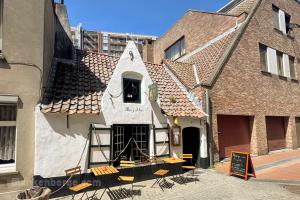
- Majutte's cottage (1775): Majutte's cottage in the Breydelstraat is one of the two surviving fishermen's cottages and shows how a fishing family lived in the 18th century.
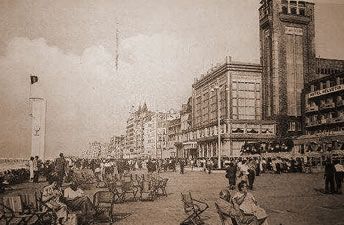
The rise of the seaside resort (1723 to 1914)
From the 18th century, first the people of Bruges and later wealthy bathers from all over Europe discovered the beach of Blankenberge.
- Day trippers from Bruges (1723): the road to Bruges built in 1723 brought the first day trippers to the sea; there was no beach tourism yet.
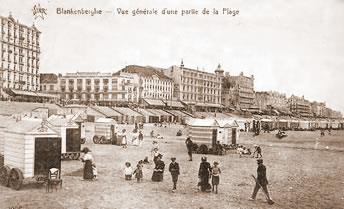
- First bathing huts (1838): under English influence the first bathing huts appeared on the beach in 1838, soon followed by a wooden promenade and the first hotels.
- Casino Kursaal (1859): in 1859 the first Casino Kursaal was built, the start of the entertainment architecture on the promenade.
- The railway (1863): on 16 August 1863 the railway between Bruges and Heist opened with a stop in Blankenberge, and that was the big breakthrough.
- The steam tram (1886): in 1886 the steam tram ran from Ostend to Blankenberge, the forerunner of today's Coastal Tram; in 1908 it was extended to Heist.
- Monaco of Belgium: during the Belle Époque the promenade was lined with luxury hotels and villas, and even Archduke Franz Ferdinand came to visit regularly.
- Villas from 1894: three restored villas from 1894 now form the Belle Epoque Centrum, a museum about this golden age.
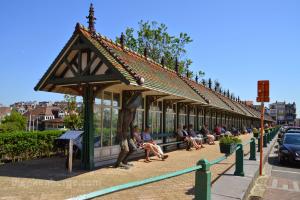
- The Paravang (1908): by the harbour stands the Paravang, an elegant Belle Époque windbreak for strolling bathers.
The Blankenberge Pier
The Pier is the best known landmark of Blankenberge and has an eventful history.
- The first pier (1894): on 12 August 1894 a cast iron Art Nouveau pier of 350 metres opened, the first of its kind on the European mainland.
- Set on fire (1914): on 15 October 1914 the German occupiers set the pier on fire.
- The concrete pier (1933): in 1933 a new concrete pier was built to a design by Jules Soete.
- Saved (1944): in the Second World War the pier survived because the German sergeant Keseberg ignored the order to blow it up.
- Renewed (2003): after years of renovation the Blankenberge Pier reopened in the summer of 2003.
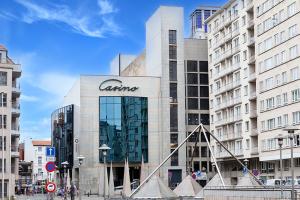
Two world wars
Because of its location between the ports of Zeebrugge and Ostend, Blankenberge was hit hard in both world wars.
- First World War: the Germans built defensive batteries in Blankenberge and destroyed the cast iron pier.
- Between the wars: the tourists soon returned, and between 1932 and 1934 today's Art Deco Casino rose on the site of the old casino.
- Fishing disappears: in 1925 the fishing fleet still had 51 boats, in 1939 only 19.
- Atlantic Wall: in the Second World War the Germans built part of the Atlantic Wall here, demolishing some of the seafront buildings; Allied bombing also hit the promenade and the Grote Markt.
- Liberation (1944): in 1944 the Germans destroyed the harbour, and on 9 September 1944 Blankenberge was liberated by the Canadian Manitoba Dragoons, which is commemorated every year on the Manitobaplein.
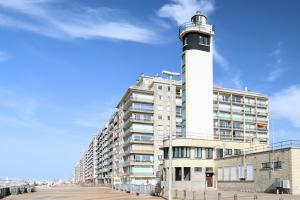
Reconstruction, marina and mass tourism
After 1945 Blankenberge got a new face, with a marina instead of a fishing port and apartments instead of villas.
- New lighthouse (1950): in 1950 today's Blankenberge lighthouse opened, and the jetties were also restored.
- Marina (1955): on 9 July 1955 the marina was inaugurated; after extensions in 1980 and 2004 the marina is one of the largest on the coast.
- Apartments on the promenade: in the reconstruction solidity came before beauty, and grand hotels such as the Hôtel des Bains et des Familles made way for apartment blocks in the mid 1950s.
- Mass tourism: in the 1960s and 1970s Blankenberge became a popular resort for families from all over Belgium, with campsites and holiday centres.
- All year round: since the 1990s attractions such as Sea Life, car-free shopping streets and art such as the sculpture Saltimbanque from the Beaufort 2012 art triennial have made the town attractive in every season.